Restored Property Safety
Eliminate secondary fall hazards like suspended limbs and cracked branch unions left by high winds.
Post-storm tree cleanup, hung-up branch extraction, and insurance-ready tree management in Ballarat North.
Providing post-storm tree recovery across Ballarat North and surrounding Ballarat suburbs.
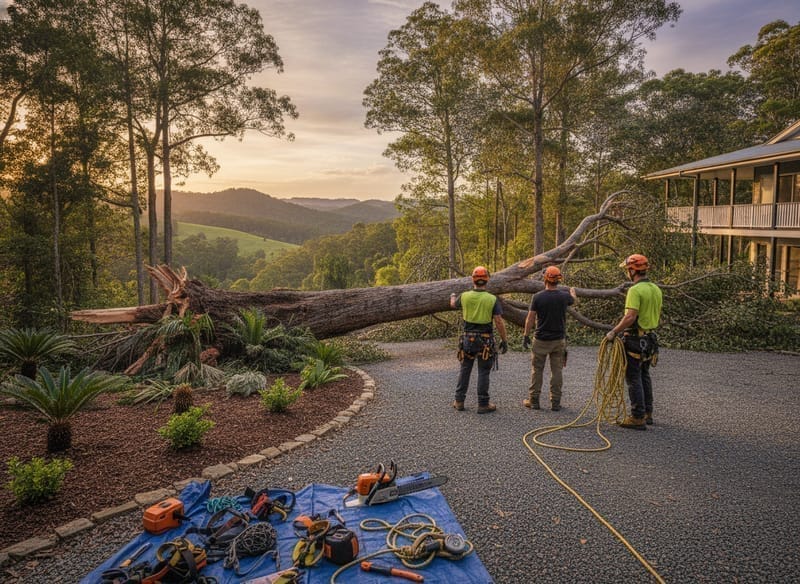
Severe weather across the Ballarat plateau brings damaging wind gusts and heavy rain that frequently snap mature limbs and topple saturated root systems. Our storm damage tree removal Ballarat North service is designed to clear fallen timber, make fractured trees safe, and restore your property to pristine order.
Ballarat North's elevation means it bears the brunt of cold frontal wind systems. When severe storms strike following weeks of winter rain, mature elms, poplars, and eucalypts are prone to root-plate failure in heavy, saturated volcanic clay, often requiring complex multi-tree clearing operations.
Eliminate secondary fall hazards like suspended limbs and cracked branch unions left by high winds.
Receive clear, itemized paperwork and damage photos to help streamline your property insurance claim.
Professional remedial pruning on torn branches helps surviving trees recover rather than succumb to rot.
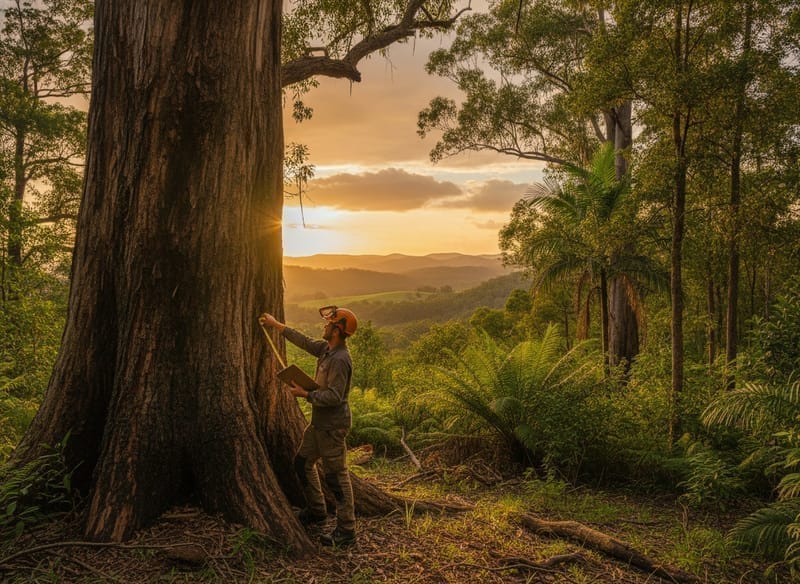
We survey the entire property to identify fallen timber, root-plate shifting, and hanging canopy hazards.
We establish a clear schedule focusing first on structures and access ways, followed by general yard clearing.
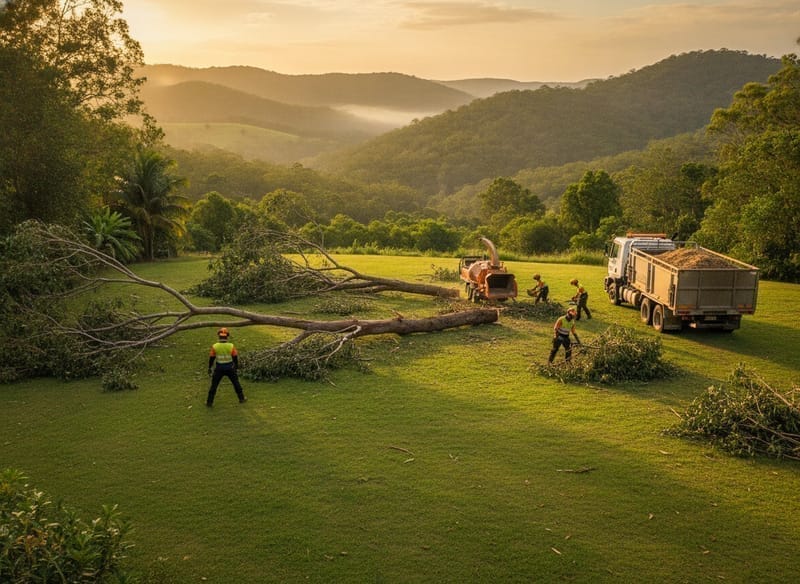
Our team cuts, rigs, and chips the storm debris using commercial chippers and chainsaws.
We sweep hard surfaces, remove all timber or cut it for firewood, and leave your yard safe and neat.
When severe cold fronts and violent wind events strike the Central Highlands, professional Storm Damage Tree Removal Ballarat North is critical to safeguard your family, home, and property. Ballarat North sits at an elevated plateau between 400m and 450m above sea level, making it highly vulnerable to severe westerly gales and winter storm fronts. Properties across the area feature an established mix of historic gold-era exotics—such as English Oak and English Elm—alongside massive indigenous Messmate and Manna Gum trees. When heavy winter and spring rains saturate the local volcanic clay soils, mature root plates lose their grip. Combined with sudden gale-force gusts, this leads to split trunks, torn leader branches, hung-up limbs, and complete tree failures across roofs, driveways, and boundary lines. Our experienced team of qualified arborists provides help across Ballarat North, Soldiers Hill, and Invermay. We deploy specialised climbing crews and heavy extraction equipment to stabilise and remove storm-damaged trees safely, preventing secondary damage to your property.
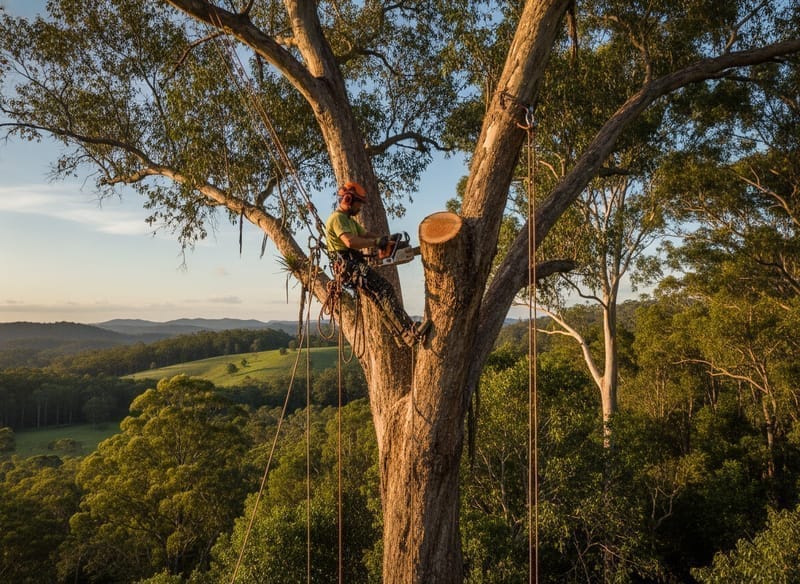
Attempting to cut or clear storm-damaged trees without qualified arborist training and commercial rigging gear is extremely hazardous. Storm-damaged timber rarely lies flat; branches and trunks are held under immense kinetic tension and compression. An inexperienced operator making a standard chainsaw cut can trigger a violent 'barber's chair' trunk split or severe tension spring-back, with forces capable of causing fatal injuries or catastrophic structural impact. Furthermore, partially uprooted root plates can violently snap back into their subterranean cavity once the heavy trunk is severed, crushing anything in the immediate drop zone. Inexperienced contractors also frequently miss hidden structural fractures, weakened branch unions, and dangerous overhead 'widow-makers' lodged high in the canopy. Our team of trade-qualified arborists approaches every storm event with rigorous mechanical risk management. We utilise high-capacity winches, dynamic friction rigging, and precision directional relief cuts to neutralise kinetic tension safely. All remedial works on surviving canopy structures are conducted strictly in accordance with AS4373 (Pruning of Amenity Trees), preventing jagged tear wounds and protecting the long-term structural integrity of your retained trees.
Our crews deploy specialised arboricultural techniques and commercial equipment to manage hazardous, storm-damaged trees safely and efficiently:
Executing precision arborist relief cuts, including bore cuts and multi-stage directional bypasses, to neutralise severe rotational torque and spring-pole forces in fallen timber without chainsaw pinch or dangerous kickback.
Utilising mobile cranes and certified rigging slings to lift compromised tree sections up and over buildings, fences, and utility lines where ground access is blocked or the tree base is structurally compromised.
Deploying truck-mounted EWPs and narrow-access tracked spider lifts up to 26m to reach cracked leader stems and hung-up branches without placing climbing arborists into structurally unstable tree canopies.
Advanced climbing techniques deployed by AQF Level 3 arborists using impact-rated rigging blocks, lowering devices, and heavy synthetic lines to systematically dismantle storm-damaged trees in confined residential yards.
Securing partially upheaved root plates and leaning stems with multi-ton Tirfor winches and heavy vehicle anchors to prevent uncontrolled rolling or snap-back during sectional log extraction.
Processing dense storm debris on-site using 12-inch commercial wood chippers and high-output ground saws (MS500i and 572XP), recycling hazardous debris into clean, usable mulch for your garden beds.
Our emergency response follows a disciplined, safety-focused four-stage process designed to eliminate hazards, protect structures, and streamline property recovery: - Stage 1: Emergency Triage and Make-Safe Assessment Upon arriving at your Ballarat North property, our Senior Arborist conducts an immediate site risk assessment. We identify overhead electrical hazards, structural loads on roofs or fences, and hung-up branches. We tag trees by priority: immediate life and property threats are stabilised first, followed by blocked driveways and secondary hazards. - Stage 2: Insurance Documentation and Itemised Scoping Before commencing major works, we document all storm damage with high-resolution photographs showing trunk fractures, root plate failures, and structural impact. We supply comprehensive itemised quotes formatted specifically for direct submission to insurance providers, expediting your claim approval. - Stage 3: Controlled Rigging and Sectional Dismantling Our qualified climbers and ground crew systematically relieve tension in the canopy, using dynamic rigging blocks and tag lines to lower heavy timber piece by piece. This controlled dismantling prevents any further impact to your roofing, driveways, garden beds, or adjoining boundary structures. - Stage 4: Chipping, Debris Extraction, and Site Cleanup We process all fallen brush and limbs through our heavy wood chippers, either leaving premium organic mulch on-site for your garden or hauling it away in our tipper trucks. We thoroughly rake and blow down the work zone, leaving your property safe, clean, and fully accessible.
Executing compliant Storm Damage Tree Removal Ballarat North requires strict alignment with Australian Standards and local planning provisions. All remedial pruning and crown restoration follow AS4373-2007 (Pruning of Amenity Trees) to prevent fungal decay, while structural assessments adhere to AS4970-2009 (Protection of Trees on Development Sites). Our field personnel are trade-certified arborists holding AQF Level 3 in Arboriculture, Working at Heights (RIIWHS204D), Chainsaw Operation (FWPCOT tickets), and EWP licences. We are fully insured with comprehensive public liability cover and WorkCover for total property owner protection. Under the City of Ballarat Planning Scheme, emergency tree removal is exempt from standard permit requirements (including Clause 52.37 Canopy Trees and Vegetation Protection Overlay Schedule 2) if a tree presents an immediate, demonstrable risk to human life or property. We document the hazard thoroughly with photographic evidence to ensure complete compliance with local council regulations and insurance requirements.
Ballarat North presents distinct arboricultural challenges driven by local geology, severe winter frosts, and historical planting schemes. Positioned high above Ballarat East and Black Hill, properties here frequently sit over Newer Volcanics basalt formations characterised by heavy clay loam over mottled clay, often interspersed with basalt floaters. During August and September, peak rainfall saturates these heavy texture-contrast clays, significantly weakening root-plate cohesion right when intense spring cold fronts deliver gale-force gusts.
The suburb features a unique canopy mix of historic exotics—such as English Elm (*Ulmus procera*), English Oak (*Quercus robur*), and Horse Chestnut (*Aesculus hippocastanum*)—alongside indigenous eucalypts like Messmate (*Eucalyptus obliqua*) and Manna Gum (*Eucalyptus viminalis*). While unpruned exotics often suffer limb shear and trunk splits under heavy rain loads, mature native gums are vulnerable to whole-tree uprooting during sudden squalls.
Furthermore, the historical goldfield mining belt running through neighbouring Black Hill and Ballarat East requires careful ground assessment before siting heavy crane outriggers or machinery. We also account for the City of Ballarat's VPO2 overlay (which protects trees over 4m in front gardens), ensuring all storm-remedial works strictly preserve visual amenity and adhere to planning guidelines.
Once emergency hazards are cleared, ongoing monitoring is essential to ensure that surviving canopy trees recover from severe mechanical wind stress. Inspect the ground around retained trees for soil mounding, root plate lifting, or newly exposed soil cracks, which indicate subsoil root shear. We recommend implementing the following maintenance care plan: - Spread a 75mm layer of coarse woodchip mulch across root zones to rebuild soil biology and maintain even moisture in heavy Ballarat clays. - Avoid driving heavy vehicles or storing materials within the Tree Protection Zone (TPZ) to prevent root compaction. - Schedule a follow-up inspection within 6 to 12 months to evaluate structural wounds, monitor stress-induced epicormic shoots, and remove secondary deadwood. Contact our team if you notice weeping trunk fissures, hollow formations, or sudden canopy deflection following subsequent high-wind events.
Storm damage cleanup pricing in Ballarat North is calculated based on scope, risk, and equipment requirements:
We provide honest, upfront itemised quotes with clear breakdown for insurance and private recovery.
We provide comprehensive storm damage tree removal across Ballarat North and all neighbouring districts, including:
Contact our experienced arborists for efficient storm cleanup and hazardous tree removal.
Get a Free Quote