Restored Property Safety
Eliminates dangerous hung-up branches and ground-level trip hazards from your family yard.
Comprehensive cleanup of storm-damaged canopies, shattered limbs, and uprooted trees across Black Hill.
Restoring storm-damaged properties across Black Hill, Soldiers Hill, and Ballarat North.
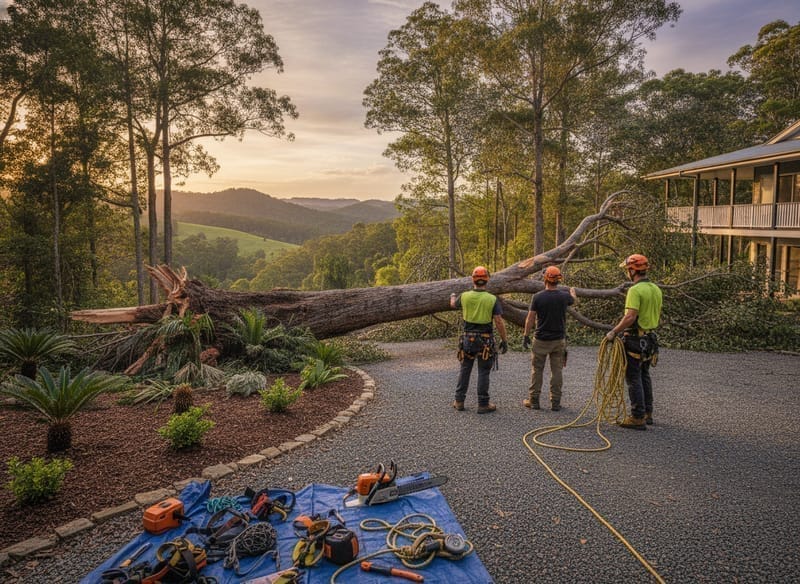
Ballarat's severe winter storms and gale-force wind events can cause widespread canopy destruction. Our storm damage tree removal Black Hill team cleans up broken limbs, uprooted gums, and shattered exotic trees.
Events like the June and October 2021 storms showed how vulnerable Black Hill's elevated ridgeline is to mass tree failure. Saturated clay soils combined with 100km/h gusts cause heavy European elms and native messmates to split or uproot across steep boundaries.
Eliminates dangerous hung-up branches and ground-level trip hazards from your family yard.
Clear photographic evidence and professional documentation speeds up insurance claim approvals.
Expert remedial pruning rescues torn trees that would otherwise rot and require full removal later.
We survey the entire property to identify fallen timber, hanging branches, and cracked branch forks.
We secure the most dangerous trees first, neutralising branches under tension or resting on buildings.
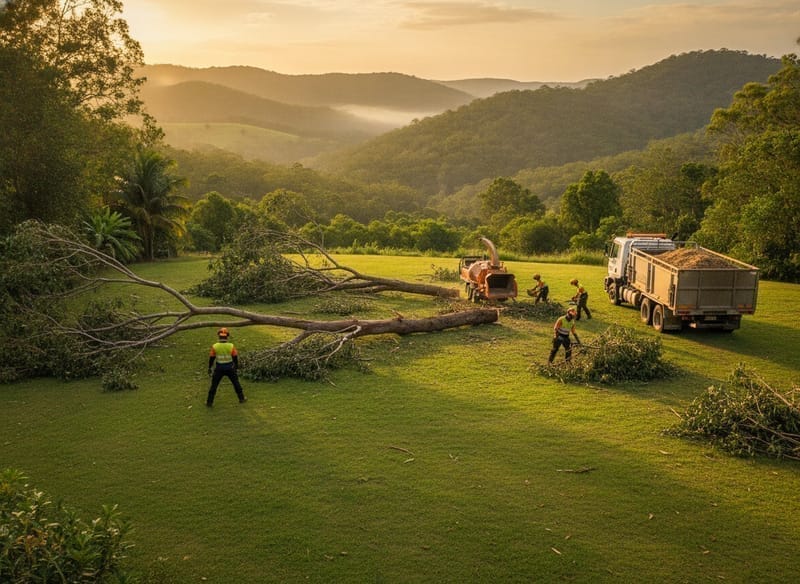
Our ground crews and climbers process fallen wood through high-capacity chippers.
We clean-cut torn branch stubs on standing trees to prevent fungal infection and heart rot.
We rake up small twigs, sweep hard surfaces, and leave your property safe and orderly.
When severe weather strikes our steep terrain, rapid Storm Damage Tree Removal Black Hill is essential to protect your home and restore safe access. Ballarat is known for its brutal winter chills, sub-zero frosts, and highly destructive spring winds which routinely test the structural limits of our mature canopy. Both of the city's recent mass failure events landed in the late winter and spring window, when our local texture-contrast soils—dark clay loam sitting over heavy mottled clay—become saturated and soft. Saturated soil combined with fierce gales often results in catastrophic root plate failures, particularly on the sloping, elevated blocks that define Black Hill. Whether a towering indigenous Messmate has snapped a major limb over your driveway, or a heritage English Elm has been uprooted in your front yard, our local team is ready to respond. We understand the immediate, overwhelming stress of waking up to a tree resting on your roof or crushing a fence. Our arborists prioritise swift, safe emergency response. We bring the heavy machinery and the advanced climbing expertise required to secure your property, prevent secondary damage, and help you navigate the ensuing insurance process with confidence.
Attempting to clear storm-felled trees without professional arboriculture qualifications is highly dangerous. Wind-thrown timber is notoriously unpredictable and behaves very differently to a standing tree. Trunks and tangled branches are often pinned under immense pressure, loaded with hidden tension and compression wood. A single incorrect chainsaw cut by a homeowner can cause heavy logs to snap back violently, barber-chair, or roll, resulting in severe injury or devastating secondary damage to nearby structures. Furthermore, under-qualified operators or 'storm chasers' often resort to panic-lopping. They will indiscriminately strip the canopy of surviving trees in a misguided attempt to make a site 'safer'. This approach directly violates AS4373 pruning standards. Lopping leaves large, jagged stubs that promote internal decay and trigger weak, fast-growing epicormic shoots, ultimately creating a much greater failure hazard for the following storm season. Our qualified climbing arborists take a systematic, scientifically sound approach to every storm site. We have the rigorous training required to safely read load and tension in fallen timber, dismantling it precisely without risking a sudden release of energy. Where a tree is damaged but salvageable, we perform targeted restorative pruning—such as selective weight reduction or crown thinning—ensuring the long-term health, aesthetic value, and stability of your remaining garden.
Storm recovery on sloping terrain demands highly specialised equipment, rigorous safety protocols, and advanced rigging techniques. Here is how our arborists safely manage complex wind-thrown and damaged trees.
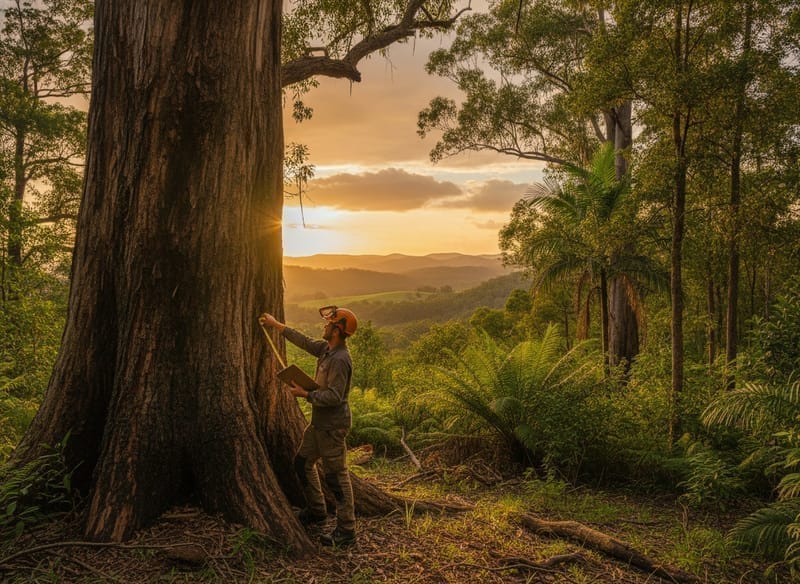
We identify hung-up limbs, split forks, and compromised root plates. Given Ballarat's wet winter soils, we carefully assess soil heave and root tearing around surviving trees before deploying our crews into the drop zone.
Fallen or tangled trees are dismantled using advanced chainsaw techniques to safely release stored energy in tension and compression wood. This precise cross-cutting prevents snap-back injuries and uncontrolled log rolling on steep slopes.
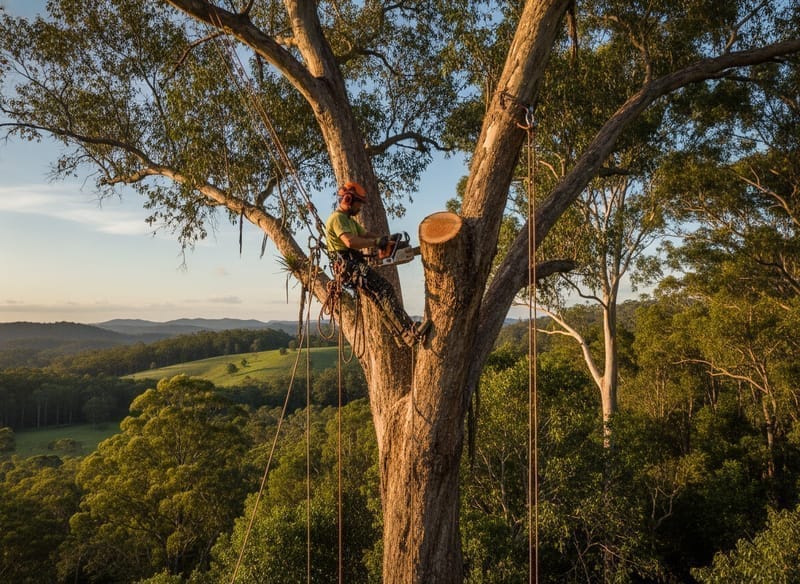
For steep Black Hill blocks where elevating work platforms (EWPs) cannot reach, our AQF Level 3 climbers utilise advanced double-rope techniques to safely rig and piece down shattered canopies hovering over rooftops.
When a massive English Oak or Manna Gum fails onto a structure, we coordinate heavy mobile cranes. This allows us to lift entire sections of timber vertically, eliminating the need to drag heavy loads across vulnerable roofing.
Processing a mature storm-felled tree generates an immense volume of vegetation. We deploy high-capacity 12-inch chippers and loader cranes to swiftly clear massive log rounds and saturated brush off your property.
As the trusted local team for Storm Damage Tree Removal Black Hill, we structure our response to prioritise your immediate safety and expedite your home insurance claims. Step 1: Rapid Deployment and Triage Upon arriving at your property, our arborists conduct a rapid site walk to categorise the damage. Immediate hazards—such as a tree resting heavily on a house, shed, or powerline—are dealt with first. Secondary hazards, like hung-up limbs suspended in the upper canopy, are taped off and flagged for the next phase. Step 2: Emergency Make-Safe Operations Our primary goal in the first hours is to stop ongoing damage. We isolate the hazard, often securing compromised limbs with ropes and heavy-duty rigging before carefully dismantling only the sections directly impacting your home or blocking crucial driveway access. Step 3: Insurer-Ready Documentation We know exactly how insurance assessors operate. Before removing the bulk debris, we take comprehensive site photos and provide a detailed, itemised quote. This paperwork clearly separates the emergency make-safe work from general property cleanup, smoothing the path for a successful claim. Step 4: Full Processing and Cleanup Once the site is secure and you are ready to proceed, our tipper trucks, skid steers, and heavy-duty chippers arrive. We systematically process the heavy timber, transport the log rounds off-site, and rake the work area clean, leaving your property safe, tidy, and accessible once more.
Storm damage environments are chaotic and high-risk, making strict adherence to safety frameworks non-negotiable. All our restorative pruning and complex dismantling work complies strictly with AS4373 (Pruning of Amenity Trees). If your storm-damaged site involves retained trees near rebuilding or repair efforts, we apply AS4970 standards to establish structural root protection zones.
Our ground crews and climbers hold all necessary high-risk qualifications, including AQF Level 3 in Arboriculture, Working at Heights, EWP operation, and advanced tree felling units. We operate fully insured with comprehensive Public Liability and WorkCover, completely shielding you from any financial or legal liability while we undertake dangerous extraction work on your property.
Working in Black Hill brings unique geographical and regulatory challenges that out-of-town operators often miss. The steep, sloping terrain requires highly skilled rope-access arborists, as cherry pickers simply cannot navigate the inclines safely. Furthermore, the Ballarat East Goldfield runs directly beneath this area; unrecorded rush-era mine shafts make the siting of heavy loader cranes or stump grinders incredibly risky without careful local assessment. Navigating the City of Ballarat planning scheme is also critical. The Vegetation Protection Overlay Schedule 2 (VPO2) protects both exotic and native trees from just 4m high in front gardens, while Clause 52.37 regulates canopy trees near boundaries. Crucially, emergency work is exempt if a tree presents an immediate risk of injury or property damage. However, this exemption only permits removing the specific part creating the hazard. Our team accurately documents the structural failure to ensure your emergency removal remains strictly compliant with council regulations.
Once the immediate storm damage is cleared, your surviving canopy requires careful observation. In the weeks following high-wind events, frequently check the base of your remaining trees for any signs of soil cracking, lifting, or heaving. This is a primary indicator of unseen root plate damage in Ballarat's heavy clays. You must also monitor previously sheltered trees that have suddenly been exposed to the wind due to the loss of a neighbour, as they are highly susceptible to failure in the next gale. We highly recommend booking our arborists for a follow-up visual assessment six months after a major storm to check for late-onset structural decline, ensuring your property remains safe year-round.
Storm damage cleanup costs vary based on the number of affected trees, the complexity of structural damage, and machinery requirements.
We provide detailed, transparent quotes suitable for direct submission to insurance companies.
Providing post-storm tree cleanup across Black Hill and neighbouring Ballarat communities.
Contact our local arborist crew for thorough storm cleanup and insurance-ready tree work.
Get a Free Quote